Posts

Is 0.999... = 1? (spoiler alert: no it is not)

You may have encountered the popular claim that \( 0.999... = 1 \), where the three dots signify that the decimal continues forever. This is a somewhat weird claim, since it would mean that mathematics is broken. There should be no way for two different numbers to have the same value. What makes it weirder is that this is quite popular claim. I've even seen mathematicians say that it's true! But is it though? One popular proof is to first denote \( S = 0.999...\) and then multiply by \(10\) to get \( 10S = 9.999...\) and subtract \( S \) from it, to get  \( 10S - S = 9.000...\) and finally dividing by \(9\) yields  \( S = 1.000... = 1 \) and we see that  \(0.999... = 1\)! However, there's a problem. This short derivation is not strictly speaking correct. It is veeeery close to being correct, and to see why let's look at finite decimals first. Let's say that \(S = 0.999\) (note that this is not the same as \(S = 0.999...\) ). Let's do the same trick as ...
The Nobel prize in physics 2018: light all the way

Image
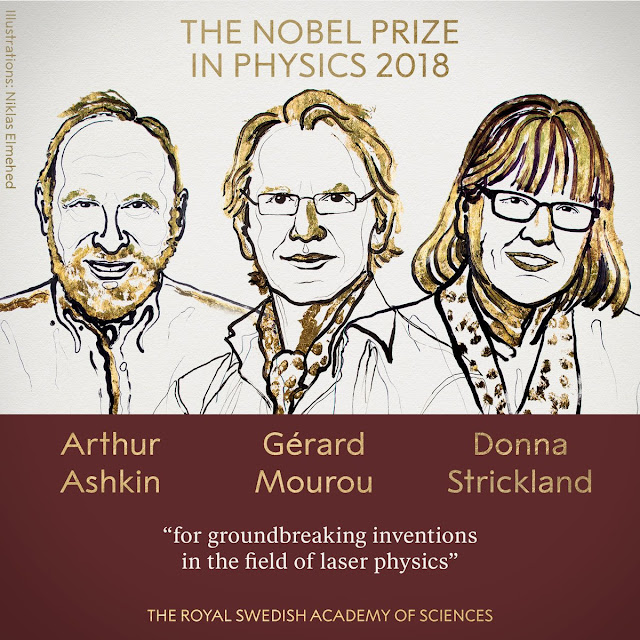
As you probably know, the 2018 Nobel prize in physics went to optics and photonics. I cannot say I am surprised, since a lot of the physics Nobel prizes are awarded to this area, either directly or indirectly. It's still nice to see that the people who really deserve recognition are finally getting it. But what is their research really about, and why should we care? Let's start with Arhur Ashkin, who at the age of 96 years, is the oldest Nobel Laureate ever. Ashkin received one half of the prize “for the optical tweezers and their application to biological systems”. Optical tweezers are exactly what they sound like, a tool used to trap and manipulate minuscule things. The tweezers were born from the observation that a dielectric particle tends to move towards the highest intensity in a beam of light. So if the particle you are trapping moves to the edge of the beam, a restoring force will move it back towards the center. This force can be explained for Rayleigh s...

Is it possible to make a laser out of wood?

Image
Wood is a precious material. It has been used for thousands of years as fuel, in construction, for tools and weapons, as well as for furniture and paper. It is also important for biochemistry in the production of purified cellulose and its derivatives, such as cellophane and cellulose acetate. Wood has unarguably been the most important raw material that allowed civilizations to flourish and it will probably remain that way. But quite recently the usefulness of wood has expanded to a completely new area: photonics and optics. When you think about it, it sounds improbable, or even down right stupid to use wood as a material in optical physics, but that's really what has been going on! Let me be clear, this is not the type of wood you would traditionally use, but chemically treated so that it transmits light. The process is simple in principle, you just soak some wood in a chemical that dissolves lignin. Then you take the delignified wood and add epoxy to it, and voila! You...

Arrow of time - reversed or not?

Image
I wrote some weeks ago about the basic concepts behind entropy and the arrow of time . It also conveniently served as test of MathJax . If you have a blog or website where you want to show some equations, you can apply MathJax with a short string of html code, and voila, nice clean LaTeX typesetting becomes available! Okay, enough advertising and let's get on with it. The two main reasons I wrote about entropy last time, is because 1. it is one of the most fascinating concepts in all of physics and 2. there are some fairly recent studies I wish to write about, and one needs to understand some basics before I go deeper into those. There was this one study that was circulated widely in popular science channels, which got hyped into the form: "scientists reversed the arrow of time!" Spoiler alert, no they didn't. I'm not saying that what the group did wasn't seriously cool and a great advancement, it's just that they didn't do what it sai...

Laser awesomeness - The European XFEL

Image
Lasers are awesome, and I guess most people would agree since they have become so common. Anyone can buy a laser pointer with pocket change, and laser shows are used as attractions at night clubs. Blu-ray discs got their name from the type of lasers they are recorded and played with, and almost all production lines utilize lasers at some point. You can even get a car with laser headlights ! But you know what kind of lasers are the most awesomest? The really big and powerful ones, and it doesn't get much bigger or more powerful than the European X-ray free electron laser, or European XFEL for short. European XFEL is an incredible research facility housing one of the most ridiculous lasers ever made by human kind. It's a humongous device, stretching over a length of 3.4 kilometers underground, and it's construction cost is an estimated 1.22 billion euros. The operation of the device sounds like it's taken straight from some sci-fi show. First, on the ...

How large is infinity?

Image
If you are like most people, then you have probably heard children arguing over some kid thing. Have you ever been astonished how easily they resort to infinity? It's like these kids don't even know how large it really is! But how large is infinity? Let's start looking into it with some actual numbers that you can write down in some form. The first really big and easy to understand number is googol . You can google it, googol is a real thing, and Google is actually a misspelling of googol. (Fun fact: the study of very large numbers is called googology.) Googol is simply \(10^{100}\). That's 1 followed by a hundred zeros, so yeah, it's quite a large number. One way to illustrate the size of googol is to compare the mass of the electron, which is \(10^{-31}\) kg, to the estimated mass of the universe, about \(10^{50}\) or \(10^{60}\) kg. If you take one googol of electrons, their mass will be up to \(10^{19}\) times larger than the mass of the whole un...

The many problems of time travel

Image
Time travel is a popular concept in works of fantasy, with many different flavors. In the Back to the Future trilogy, Doc Brown built a time machine out of a DeLorean just because he could. In Harry Potter and the Prisoner of Azkaban, Hermione Granger uses a time-turner  so she could study every subject in Hogwarts, and even Superman turns back time to undo the death of Lois Lane. Seems like Superman really is quite super. But scientifically speaking, how much sense does time travel actually make? Let's start from the most obvious type of time travel: forward in time. Clearly we are all automatically traveling towards future time by default, since we age and seasons shift and whatever. But the interesting thing is that according to the theory of relativity, it is possible to slow down the passage of time for yourself, while everything else around you continues to age normally. This effect is called time dilation , and it is an important effect in the universes dynamics....

Entropy and the arrow of time

Image
When you whisk an egg and leave it alone, why doesn't the egg white and yolk separate on their own? If you light a fire, why does it keep burning? And why do we perceive that time never changes it's direction? All of these questions are answered by a single concept in physics: entropy. Simply put, entropy is a measure of the microscopic disorder of a system, and the second law of thermodynamics says that it can only increase or stay constant in a closed system. And all of this is just simple statistics. Let's put this in more concrete terms with a simple example: we flip three identical coins and record the outcome. First of all, what does this have to do with anything? In thermodynamics, we are interested in the energy of the studied system. That energy is made up of all of the individual energy states of the particles that make up the said system. The two sides of a coin represent the possible states of a two level system, which makes it quite a popular example. ...